
The Commoditization Evidence: When Syntax Becomes Worthless
The Commoditization Evidence: When Syntax Becomes Worthless. Agentic Codebases: The Infrastructure Revolution.
The numbers don't lie about code's commodity status. Major tech companies report unprecedented AI code generation rates, but the real story emerges when you examine what humans actually do during their workdays.
The shift from writing to reading has already happened [3]. Developers spend more time understanding, evaluating, and directing AI-generated code than writing it from scratch. The bottleneck moved from "How do I implement this?" to "Should this be implemented?" and "Can I trust this implementation?"
This creates what researchers call "Mean Time to Understanding"—the irreducible human element in an age of infinite code [4]. AI can generate syntactically perfect functions in milliseconds, but humans still need time to comprehend context, implications, and integration challenges.
The verification bottleneck is real. When AI generates plausible-looking code at scale, the cognitive load shifts to validation. Teams report spending 60-70% of their time on code review, testing, and architectural decisions—the judgment layer that AI cannot yet replicate.
Key insight: The value isn't in knowing how to write a sorting algorithm. It's in knowing when not to sort at all.
Agentic Codebases: The Infrastructure Revolution
The most concrete evidence of the post-code era comes from infrastructure designed specifically for AI agents. TigerData's Agentic Postgres, launched in October 2025, represents the first database built explicitly for agent-driven workloads [5].
What makes a database "agentic"? Native search capabilities, instant forking for experimentation, MCP (Model Context Protocol) integration, and architecture optimized for high-concurrency agent access. Traditional databases assumed human operators making deliberate queries. Agentic systems assume thousands of AI agents exploring, testing, and iterating simultaneously.
The pgEdge Agentic AI Toolkit demonstrates another piece of this puzzle: secure LLM and agent access to Postgres schemas [6]. This isn't just about connecting AI to databases—it's about creating infrastructure where AI agents can safely explore, learn, and modify data structures without human intervention for routine operations.
The blueprint emerging: Liquid infrastructure that reshapes itself based on agent needs. Databases that fork like Git repositories. APIs that evolve based on usage patterns. Code that writes its own documentation and tests.
This represents a fundamental architectural shift. Traditional software assumed stable, human-designed interfaces. Agentic software assumes constant evolution, experimentation, and self-modification within defined boundaries.
The Judgment Bottleneck: Where Humans Still Matter
Context remains AI's Achilles heel in 2026 [7]. While AI excels at syntax and pattern matching, it struggles with the messy realities of business requirements, user psychology, and system integration across organizational boundaries.
The three judgment layers that remain stubbornly human:
-
Problem framing: What problem are we actually solving? AI can optimize solutions but struggles with problem definition when stakeholders disagree or requirements conflict.
-
Trust calibration: Which AI-generated solutions can we ship? The "trust via judgment" principle becomes critical when AI produces multiple plausible solutions with different risk profiles [8].
-
System design: How do components interact across organizational and technical boundaries? AI understands code interfaces but misses political, cultural, and business context.
Case study: A Nordic fintech company reported that AI reduced their feature development time by 70%, but increased their architecture review cycles by 200%. The bottleneck shifted from implementation to ensuring new features aligned with regulatory requirements, user expectations, and long-term platform stability.
The verification challenge intensifies with AI's improving plausibility. Bad human code often looks obviously wrong. Bad AI code looks professionally written, well-commented, and subtly incorrect in ways that only emerge under specific conditions.
Orchestration Science: The New Career Path
The post-coding era creates entirely new roles focused on AI orchestration—managing agent workforces like human employees [9]. These aren't traditional management roles but technical positions requiring deep understanding of AI capabilities, limitations, and coordination patterns.
AI orchestrators design workflows where multiple AI agents collaborate on complex tasks. They set boundaries, define success metrics, and handle escalation when agents encounter scenarios outside their training. Think of it as DevOps for AI workforces.
The skill set combines technical depth with systems thinking. Orchestrators need to understand what different AI models do well, how to chain agent outputs effectively, and when to inject human judgment into automated workflows.
Practical orchestration patterns emerging in 2026:
- Validation chains: Multiple AI agents review each other's work before human approval
- Specialization hierarchies: Different agents handle different aspects of complex tasks
- Human checkpoints: Strategic points where human judgment gates AI progression
- Rollback protocols: Automated systems for undoing AI decisions that prove problematic
Nordic companies lead in orchestration science, partly due to cultural comfort with automation and systematic approaches to technology adoption. The region's emphasis on consensus-building translates well to designing AI coordination systems.
Building in the Liquid Stack Era
The practical implications for builders are profound. Liquid stacks—technology architectures that reshape themselves based on AI agent needs—require different design principles than traditional software.
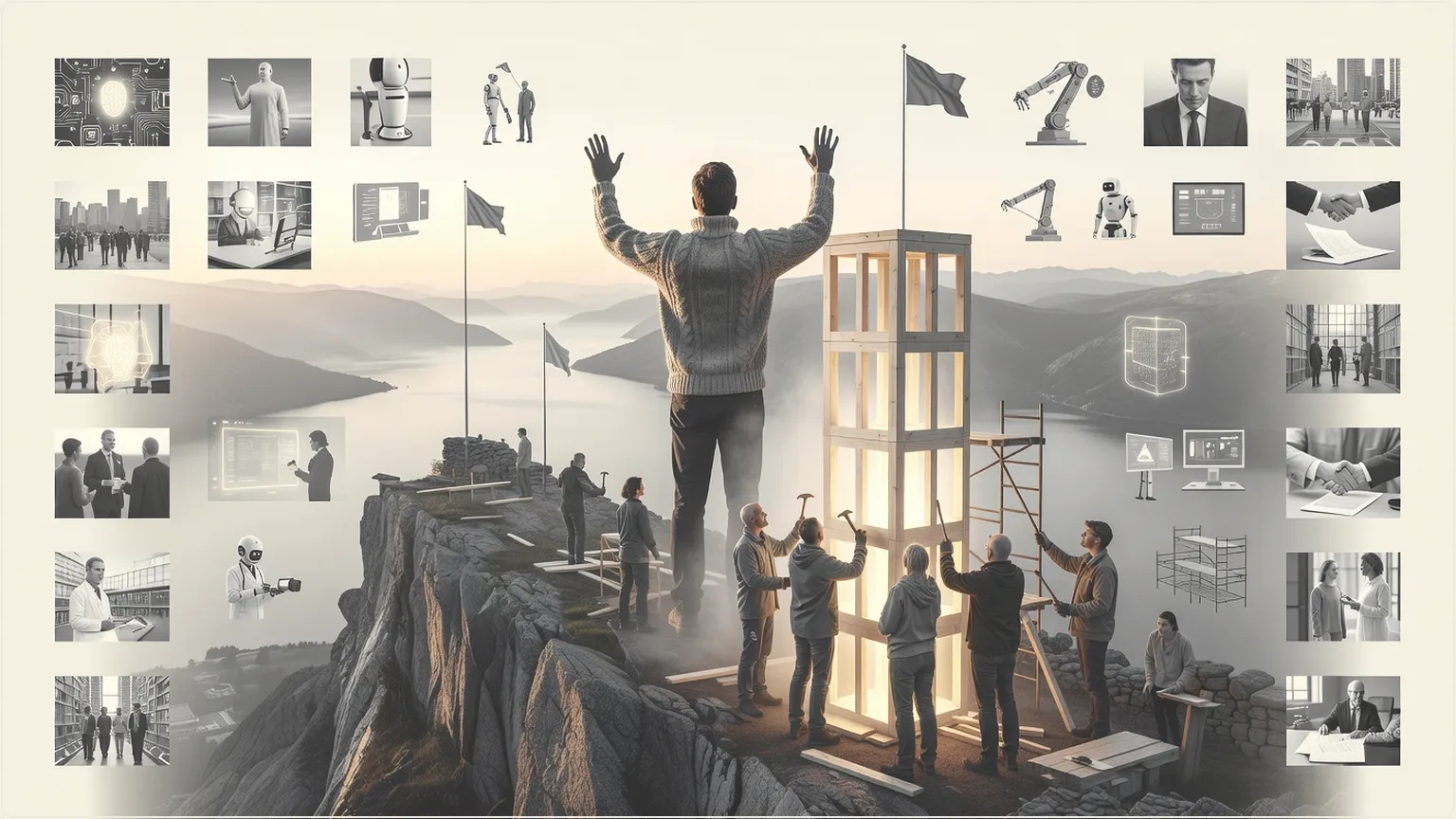
Design for agent interaction first. Your APIs, databases, and interfaces will increasingly serve AI agents rather than human users. This means prioritizing programmatic access, clear error handling, and extensive logging over human-friendly interfaces.
Embrace experimental architectures. When AI can generate and test multiple approaches rapidly, the cost of architectural experiments drops dramatically. Teams report running dozens of architectural variations in parallel, letting AI agents explore solution spaces that would take human teams months to evaluate.
Build judgment frameworks, not just code. The most successful teams in 2026 invested heavily in decision-making frameworks, evaluation criteria, and escalation protocols. These human-designed systems guide AI execution and ensure alignment with business objectives.
Monitor for drift. AI-driven systems evolve continuously. Without proper monitoring, they can drift from intended behavior in subtle ways. Successful teams implement extensive observability for AI decision-making, not just system performance.
The Nordic approach emphasizes systematic experimentation over rapid iteration. While Silicon Valley teams often deploy AI agents quickly and fix problems in production, Nordic companies prefer thorough testing and gradual rollouts. Both approaches work, but Nordic systematic thinking proves valuable for complex, regulated industries.
The Bigger Shift: When AI Builds the Software
Musk's prediction missed the timeline but captured the transformation. Programming as we knew it—humans typing code into text editors—is becoming a specialized skill rather than the default mode of software creation.
The new software development lifecycle: Humans define problems and success criteria. AI generates multiple solution approaches. Humans evaluate, select, and orchestrate implementation. AI handles execution, testing, and maintenance. Humans monitor outcomes and adjust direction.
This isn't the death of programming—it's the industrialization of software creation. Like manufacturing shifted from artisanal crafting to factory production, software development is becoming a more systematic, scalable process with humans focused on design and quality control rather than manual assembly.
The implications extend beyond individual careers to entire industries. When software creation becomes dramatically cheaper and faster, the bottleneck shifts to understanding what software should exist. Market research, user experience design, and business strategy become more valuable than implementation skills.
The Nordic advantage in this transition comes from cultural comfort with systematic approaches and consensus-building. As software development becomes more about orchestrating AI agents than writing code, Nordic emphasis on clear processes and collaborative decision-making proves valuable.
The post-code era doesn't eliminate human creativity—it amplifies it by removing implementation friction. When you can test ideas rapidly through AI execution, the limiting factor becomes imagination and judgment, not technical skill.
Code is free. Judgment isn't. In 2026, that's not just our tagline—it's the new reality of building technology.
Sources
- https://www.linkedin.com/posts/hypertrail_the-future-of-software-beyond-the-code-activity-7434628077248212992-RKaR
- https://www.linkedin.com/posts/kutyshalev_code-is-now-free-so-why-does-software-still-activity-7425295867764662272-jXyo
- https://dev.to/grahamthedev/mean-time-to-understanding-the-irreducible-human-element-in-the-age-of-infinite-code--i2o
- https://dev.to/grahamthedev/mean-time-to-understanding-the-irreducible-human-element-in-the-age-of-infinite-code--i2o
- https://dev.to/tigerdata/introducing-agentic-postgres-the-first-free-database-built-for-agents-50i7
- https://dev.to/tigerdata/introducing-agentic-postgres-the-first-free-database-built-for-agents-50i7
- https://thenewstack.io/context-is-ai-codings-real-bottleneck-in-2026
- https://www.linkedin.com/posts/kutyshalev_code-is-now-free-so-why-does-software-still-activity-7425295867764662272-jXyo
- https://www.linkedin.com/pulse/orchestration-science-post-coding-era-olalekan-ogundipe-cmhre
Want to go deeper?
We explore the frontier of AI-built software by actually building it. See what we're working on.