
Why Code Stopped Being the Constraint
Why Code Stopped Being the Constraint. Decision Fatigue Is the New Burnout. Code Review Is Dead. Long Live Behavior Review..
For fifty years, software's rate-limiting step was typing the instructions correctly. Debugging, syntax, boilerplate, integration glue — all of it consumed enormous human hours. AI coding agents broke that constraint hard and fast.
McKinsey's 2026 analysis describes a "Level 4" tier of AI-assisted development where agents deliver entire applications, giving teams roughly 20x leverage — but only when humans make the right calls on architecture, tradeoffs, and acceptance criteria [1]. The leverage is real. It's also conditional.
DeveloperWeek 2026 crystallized the sentiment across the industry: AI isn't the bottleneck anymore [5]. The scarce resources now are judgment, coordination, trust, and reliability — softer, harder-to-scale human capacities that don't compress just because compute got cheaper [5].
This is the part founders miss when they get starry-eyed about agent demos. Generating output was never the hard part of building good software. Knowing what "good" means was. AI just made that fact impossible to ignore.
Decision Fatigue Is the New Burnout
Here's the uncomfortable side effect nobody put in the pitch decks: giving everyone a 10x code generator doesn't reduce cognitive load. It relocates it.
Stack Overflow's reporting calls this out directly — coding agents are giving engineers decision fatigue [2]. When an agent can produce five plausible implementations in the time it takes to think about one, someone still has to choose. Prompt structuring, output evaluation, edge-case checking, style judgment — all of that now happens at a pace and volume no human review process was built for.
CIO Magazine's May 2026 piece put it plainly: AI compresses execution time but does nothing to compress the judgment required to decide what to build, how to weigh tradeoffs, or which edge cases matter [3]. Teams that treat AI output as a finished product — rather than a draft awaiting discernment — end up shipping faster and worse.
The practical failure mode we see constantly: a team adopts an agentic coding tool, throughput triples, and three months later they're drowning in pull requests nobody has the bandwidth to properly evaluate. Volume went up. Trust went down. That's not progress — that's technical debt with a faster on-ramp.
Takeaway for builders: if your AI adoption plan doesn't include a plan for managing decision volume, you're optimizing the wrong metric. Throughput without judgment is just entropy at scale.
Code Review Is Dead. Long Live Behavior Review.
One of the sharpest shifts in 2026 is what "reviewing code" even means anymore. Craft Better Software argues human code reviews, in the traditional line-by-line sense, are dead [7]. Nobody has the time — or honestly, the need — to read every AI-generated diff character by character.
What replaces it is review of behavior and intent. Does the system do what it's supposed to do under the conditions that matter? Are the tests meaningful, not just present? Does the architecture hold up under load, under edge cases, under six months of feature creep? That's a fundamentally different skill than spotting a missing semicolon.
The Pragmatic Engineer newsletter makes a related point worth sitting with: when AI writes almost all the code, the code that gets written faster also exposes weak engineering practices faster [6]. Bad architecture used to hide behind slow output. Now it surfaces in days, not quarters. Engineers who used to be valued for typing speed are becoming valuable for something closer to product judgment and technical leadership — deciding what the system should be, not just implementing it [6].
Growin's 2026 CTO Guide frames this as a supervisory shift: engineers increasingly act as mission-definers and evaluators rather than line-level producers, with AI agents handling execution in domains where verification is tractable [8]. The catch — and it's a real one — is that this only works well in high-verifiability domains. Where correctness is fuzzy or subjective, human judgment isn't optional; it's the entire product.
Evaluation as Infrastructure, Not an Afterthought
If judgment is the scarce resource, the smartest teams in 2026 are treating evaluation itself as a first-class piece of infrastructure — not a review meeting bolted onto the end of a sprint.
DeveloperWeek's coverage highlighted a pattern gaining traction: using smaller language models (SLMs) as judges, calibrated by humans, to triage and pre-screen AI output before it ever reaches a person's desk [5]. Humans still make the final call on anything ambiguous or high-stakes — but the volume gets filtered first. This is the same logic as spam filtering, just applied to code quality and product decisions.
Michael Novati's widely-shared analysis makes an important related point: removing the production bottleneck doesn't fix your team — it reveals what was actually broken all along [4]. Poor coordination, low trust between teams, habits built around a slower cadence — these were always there, just masked by the fact that shipping was slow enough to hide them. AI doesn't create these problems. It makes them visible in weeks instead of years.
Practical framework for builders, synthesized from what's working across 2026 case studies:
- Audit your decision points. Map every place in your current workflow where a human currently says yes/no/needs-work. That map is your real bottleneck inventory — not your codebase.
- Build guardian agents for volume, not judgment. Use automated evaluators to catch obvious failures (broken tests, security anti-patterns, style violations) so humans only see what actually needs discernment.
- Reward calibration, not throughput. If your team's incentives still reward lines shipped or PRs closed, you're optimizing for the pre-AI bottleneck. Shift review culture toward "did we make the right call," not "did we move fast."
- Make architecture and intent the review artifact. Stop asking engineers to read diffs. Ask them to evaluate whether the system's behavior matches its intended purpose.
The New SDLC: Built Around Judgment, Not Output
The software development lifecycle itself is being quietly rewritten. The old SDLC assumed the scarce resource was implementation time, so its checkpoints — design doc, code review, QA, release — were built to conserve engineering hours.
That assumption no longer holds. Multiple 2026 sources converge on the same reconfiguration: teams are restructuring around context management, architectural intent, and ethical/quality guardrails rather than implementation checkpoints [1][6][8]. The design doc matters more than ever, because it's the artifact that captures the judgment an agent can't originate on its own. The code review matters less, because the code itself is now abundant and disposable.
This has a direct implication for how teams should be structured. Fewer people are needed to produce. More capacity needs to go toward defining — writing precise specs, setting acceptance criteria, deciding what "correct" looks like before an agent starts working. The CIO piece calls this the difference between using AI to draft and using it to replace discernment entirely [3]. Draft, don't abdicate.
We see this concretely in how we build voice AI systems at Up North AI. The agent can generate dialogue flows, error-handling branches, and integration code in minutes. What still takes real time — and real senior judgment — is deciding which failure modes actually matter to a Nordic bank's customer service line versus a consumer app's onboarding flow. That's not a coding problem. It's a judgment problem, and no amount of additional compute solves it.
What Changes When AI Builds the Software
Step back and the shape of the shift becomes clear: the scarce skill in software is moving from production to discernment. For decades, the industry selected for and rewarded people who could translate intent into working code quickly. That skill is being commoditized in real time.
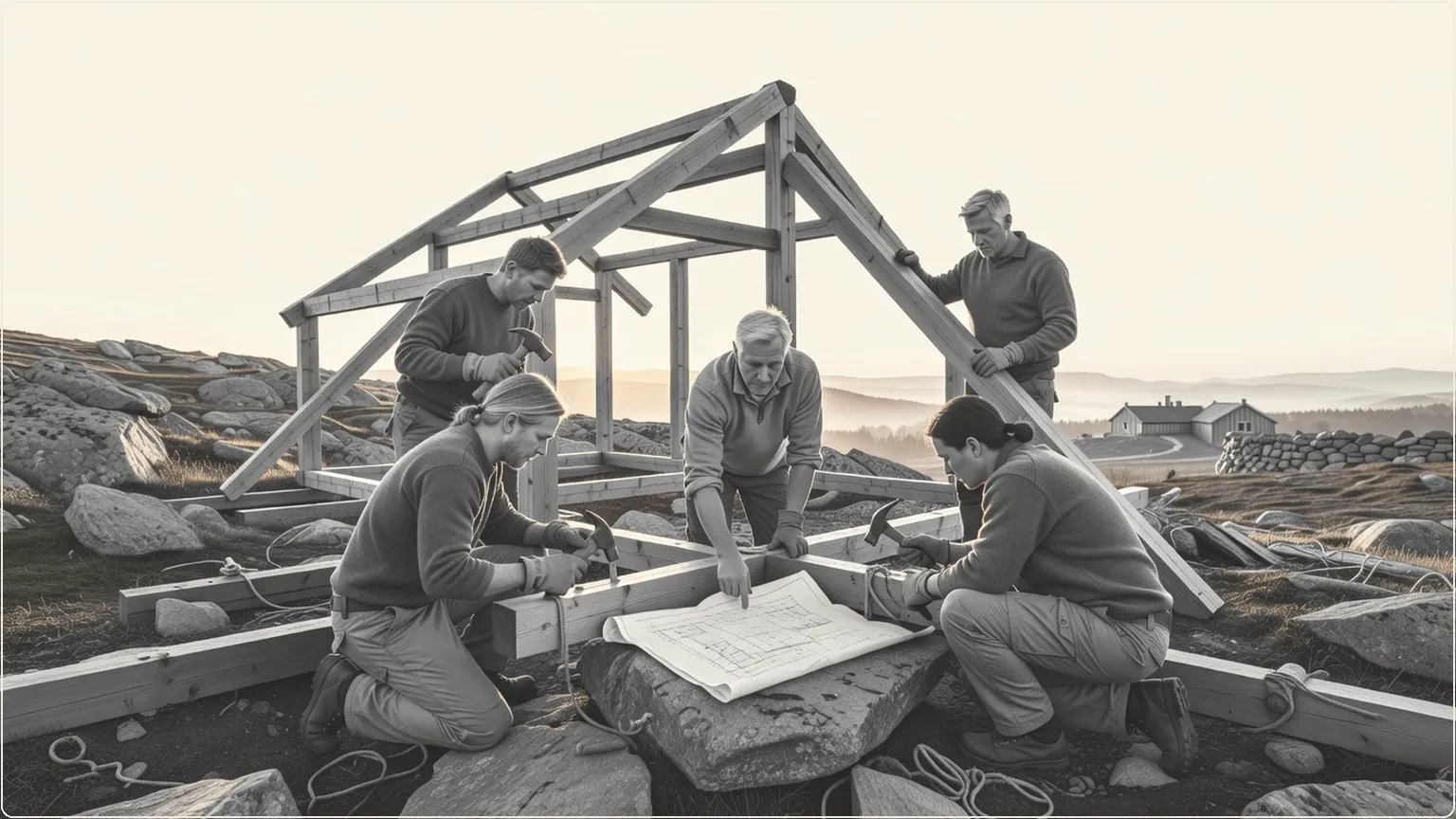
What's emerging in its place is closer to editorial judgment than engineering in the traditional sense — the ability to look at abundant, cheaply-produced output and decide what's actually good, what's actually needed, and what will actually hold up. That's a harder skill to teach, slower to develop, and much harder to fake.
It also changes who gets to build software. When the bottleneck was typing code, only people who could type code got to build. When the bottleneck is judgment — knowing what's worth building and recognizing when something's right — the field opens to people with strong product sense, domain expertise, and taste, even if their coding background is thin. That's a genuinely bigger shift than "AI writes code now." It's a redistribution of who holds leverage in the building process.
The organizations that will win this decade aren't the ones with the best coding agents — those are becoming commodity infrastructure, roughly equivalent across vendors. The winners will be the ones who build the sharpest judgment layer around those agents: the evaluation systems, the review cultures, the people trained to ask "is this actually right" faster and more reliably than everyone else.
Code is free now. That was always coming. What's scarce, what's valuable, what's genuinely hard to build — is the judgment to know what to do with it.
Sources
- https://www.mckinsey.com/capabilities/tech-and-ai/our-insights/the-ai-revolution-in-software-development
- https://stackoverflow.blog/2026/05/21/coding-agents-are-giving-everyone-decision-fatigue/
- https://www.cio.com/article/4169591/ai-coding-tools-are-changing-output-faster-than-they-are-changing-judgment.html
- https://michaelnovati.substack.com/p/the-real-bottleneck-in-the-ai-era
- https://heemeng.medium.com/developerweek-2026-made-one-thing-clear-ai-isnt-the-bottleneck-anymore-695a439d1451
- https://newsletter.pragmaticengineer.com/p/when-ai-writes-almost-all-code-what
- https://craftbettersoftware.com/p/human-code-reviews-are-dead
- https://www.growin.com/blog/ai-agents-in-software-development-26/
Want to go deeper?
We explore the frontier of AI-built software by actually building it. See what we're working on.