
Karpathy's Funnel: Who Actually Has AI Superpowers Right Now
Nvidia Eyes Reflection AI: Chips Company Wants a Model, Too. Claude Code's Multi-Agent Orchestration Goes Mainstream.
Karpathy's Funnel: Who Actually Has AI Superpowers Right Now
Andrej Karpathy updated his widely-shared capability-gap thread, and the picture he paints is stark: roughly 6 billion people (75% of humanity) have little to no real LLM contact beyond "derpy chatbots," 1-2 billion are casual users, about 20 million professionals are seeing genuine productivity gains from frontier coding/math agents, and a vanishingly small ~5,000 people with internal frontier access are running agent swarms on long-horizon tasks — full software projects, cyber ops, research-grade math and science [1][2][3].
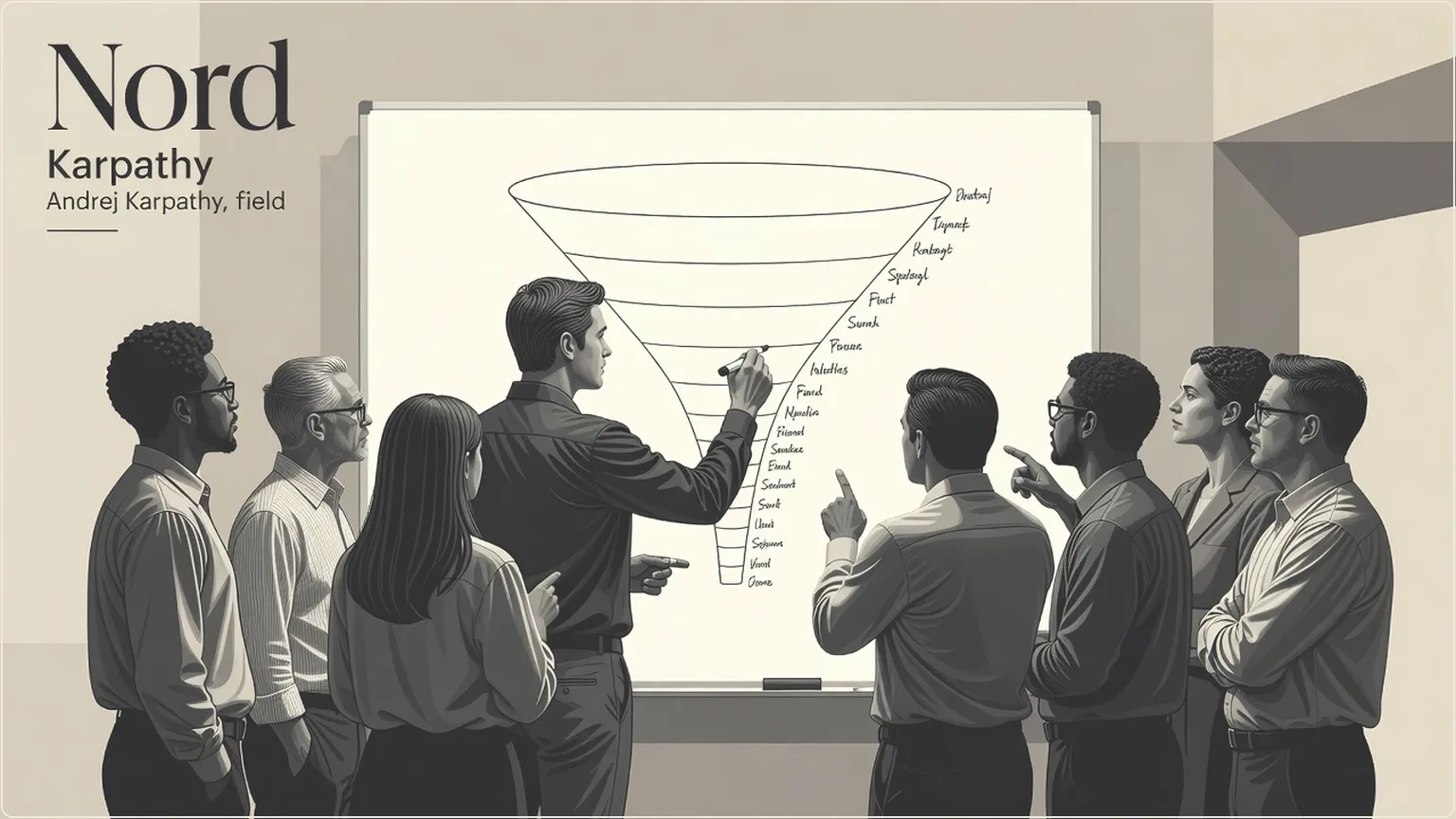
The sharper point he makes: this shift happened fast. Less than a year ago, most serious work still meant hand-coding. Now agents are completing weeks or months of work from a single prompt — for the people who have access [2][3]. The public narrative of "AI chatbots are fine but overhyped" and the internal reality at frontier labs are increasingly describing two different technologies.
For anyone building a company right now, this is the single most important data point in today's briefing. The gap isn't about model quality anymore — it's about who has access to orchestration-grade tooling and who's still typing into a chat box. That gap compounds daily.
Nvidia Eyes Reflection AI: Chips Company Wants a Model, Too
The Financial Times reports Nvidia is in early talks to acquire — or significantly deepen its stake in — Reflection AI, the open-weight model startup founded by ex-DeepMind researchers in 2024 and already backed by $800M from Nvidia [1][2]. Options on the table reportedly range from a full buyout to an acqui-hire structure designed to dodge a lengthy antitrust review [2][3]. Reflection is valued at $25B pre-money after its first open model, Beam, shipped October 5 [3].
Read between the lines: Nvidia doesn't need to sell more GPUs to justify this — it needs a credible open-weight model story as the US-vs-China open model race heats up, and as hyperscaler customers increasingly want alternatives to closed-API lock-in. Owning or controlling an open frontier model gives Nvidia leverage at every layer of the stack, not just silicon.
If this closes, it's one more sign that the lines between "chip company," "cloud company," and "model company" are dissolving. Vertical integration is the name of the game in late 2026, and nobody wants to be the sole provider of a commodity layer.
Claude Code's Multi-Agent Orchestration Goes Mainstream
While the funding headlines dominate, the more quietly important story is happening in developer workflows: Claude Code's multi-agent orchestration patterns have matured fast. Developers are now routinely running Opus as an orchestrator that delegates tasks to Sonnet or Haiku sub-agents via the Task tool, with parallel execution, shared task lists, file claiming, and MCP hooks coordinating the swarm [1][3].
Benchmarks circulating this week show Haiku handling 14 of 18 common delegated agent types at roughly 20x lower cost than using Opus for everything, with Opus reserved for architecture decisions and code review [2]. GitHub repos cataloguing 100+ specialized, reusable agent "skills" are spreading fast among builders treating this less like prompting and more like staffing a team [3].
This is the practical, on-the-ground version of what Karpathy is describing in the abstract: the shift from "I write code" to "I orchestrate agents who write code." It's happening in public repos right now, not just inside frontier labs.
What This Means For Your Business
Today's stories are really one story told four ways: the unit of value in AI is shifting from generating content to making and executing decisions, and from coding to orchestrating. TypeSafe's Jev skips text entirely and ships typed decisions. Claude Code's ecosystem is built around routing and delegation, not single-model prompting. Karpathy's funnel shows the people furthest ahead are the ones running agent swarms, not the ones writing better prompts. Even Nvidia's reported move on Reflection AI is about owning more of the decision-making stack, not just the compute underneath it.
If you're a business leader evaluating AI investment right now, the question to ask isn't "which model should we use" — it's "where in our organization are we still manually making the kind of typed, repeatable decisions that a $0.04/M-token model could make in 70 milliseconds, and where do we actually need judgment, taste, or accountability that no model can own." The companies winning in this cycle are the ones who've figured out that distinction and built orchestration layers — human and machine — around it, rather than betting everything on one model to do all of it.
The uncomfortable truth in Karpathy's thread is that the gap between "has access to agent swarms" and "uses a chatbot occasionally" is now the dominant productivity variable in tech, and it's widening weekly, not yearly. Waiting for the technology to mature before acting is no longer a neutral choice — it's choosing to be in the 75%.
Key takeaway: The winners this cycle aren't the ones with the best model — they're the ones who've rebuilt their workflows around delegation, typed decisions, and orchestration while everyone else is still asking a chatbot for help.
Sources
- https://trendandticker.com/technology/typesafe-ai-raises-870-million-jev-decision-model
- https://aipressroom.com/typesafe-ai-870m-decision-ai/
- https://venturecapitaltracker.com/typesafe-ai-870m-series-a-7-5b-valuation
- https://is4.ai/blog/our-blog-1/karpathy-llm-capability-gap-widening-627
- https://ground.news/article/andrej-karpathy-says-the-ai-capability-gap-is-now-a-sharp-funnel
- https://aibreakingwire.com/news/karpathy-describes-a-funnel-in-llm-capability-6b-barely-use-them
- https://www.reuters.com/business/nvidia-talks-invest-further-reflection-ai-or-buy-it-ft-reports-2026-10-10/
- https://www.ft.com/content/052610c5-22b4-4dd4-932e-b7f9f0628b6a
- https://santageai.com/news/2026/10/11/nvidia-reflection-ai-acquisition-talks
- https://code.claude.com/docs/llms-full.txt
- https://www.ovidius.ai/blog/claude-code-subagents-haiku-vs-sonnet-vs-opus-benchmarked
- https://github-com.translate.goog/wshobson/agents
Stay ahead of AI
No spam. Unsubscribe anytime.
Want to go deeper?
Reading the news is one thing. Exploring the frontier is another. See what we're building.