
Silent Speech Hits 200 WPM, But AI Voices Still Can't Fool Humans
DeepMind Agents Go From Prompt to Physical Robot, No CAD Required. humans& Trains a Tutor by Teaching a Simulated Student First.
Silent Speech Hits 200 WPM, But AI Voices Still Can't Fool Humans
The Subvocal Company, fresh off YC with $1.3M from YC and Afore Capital, is taking preorders on smart glasses that use RF radar to read facial muscle movements and turn silent mouth movements into text at over 200 words per minute — no sound, no typing. $499 retail, $199 deposit, shipping Q1 2027 [1][2]. If it works as advertised, it's a genuinely new input modality, not an incremental one.
Meanwhile on the output side, the Turing TTS benchmark from Voice Arena delivered a reality check: even top models like Gemini 3.8 Flash TTS only fool human listeners about 10% of the time in blind tests. That's nowhere near the 50% mark that would mean true indistinguishability. Rohan Paul and others flagged the gap on X as a reminder that voice synthesis has plateaued on naturalness even as it's gotten cheaper and faster [3].
The asymmetry here is the story: we're getting shockingly good at reading humans (silent speech decoding) faster than we're getting good at sounding human (TTS). For voice AI builders, that's a signal — input capture is becoming a solved problem sooner than output realism.
DeepMind Agents Go From Prompt to Physical Robot, No CAD Required
On Halloween, Google DeepMind showed agents powered by Gemini 4 Argon and the Antigravity platform designing, simulating, and physically building a 12-degree-of-freedom dancing robot jack-o'-lantern — from a single plain-English prompt, with zero manual CAD work [1][2]. Led by Aaron Saunders, formerly of Boston Dynamics, this wasn't a rendering or a simulation flex — it was real hardware, dancing, on command.
The seasonal framing is cute, but don't let it undersell the point: this is end-to-end agentic robotics, from natural language to mechanical design to physical assembly. Saunders' team posts drew strong engagement, with the recurring theme being the jump from "agents write code" to "agents build things in the physical world" [3].
That jump is the whole thesis of the post-code era in miniature. If an agent can go from a sentence to a dancing robot without a human touching CAD software, the judgment bottleneck moves entirely to what you ask for and whether it's any good — not how it gets made.
humans& Trains a Tutor by Teaching a Simulated Student First
humans&, backed by NVIDIA, Bezos, GV, and SV Angel, released &Tutor — a model trained not on static tutoring transcripts but by interacting with Persimmon, their large-scale simulated learner model, optimized explicitly to maximize learning gains over time [1][2]. The results are notable: 0.754 on the TutorMoments benchmark with a plain prompt, beating Claude Sonnet 5.5 (0.667) and GPT-6 Astra (0.634), and climbing to 0.919 with an evaluation-aware prompt — with the strongest rigor score (0.931) of any model tested.
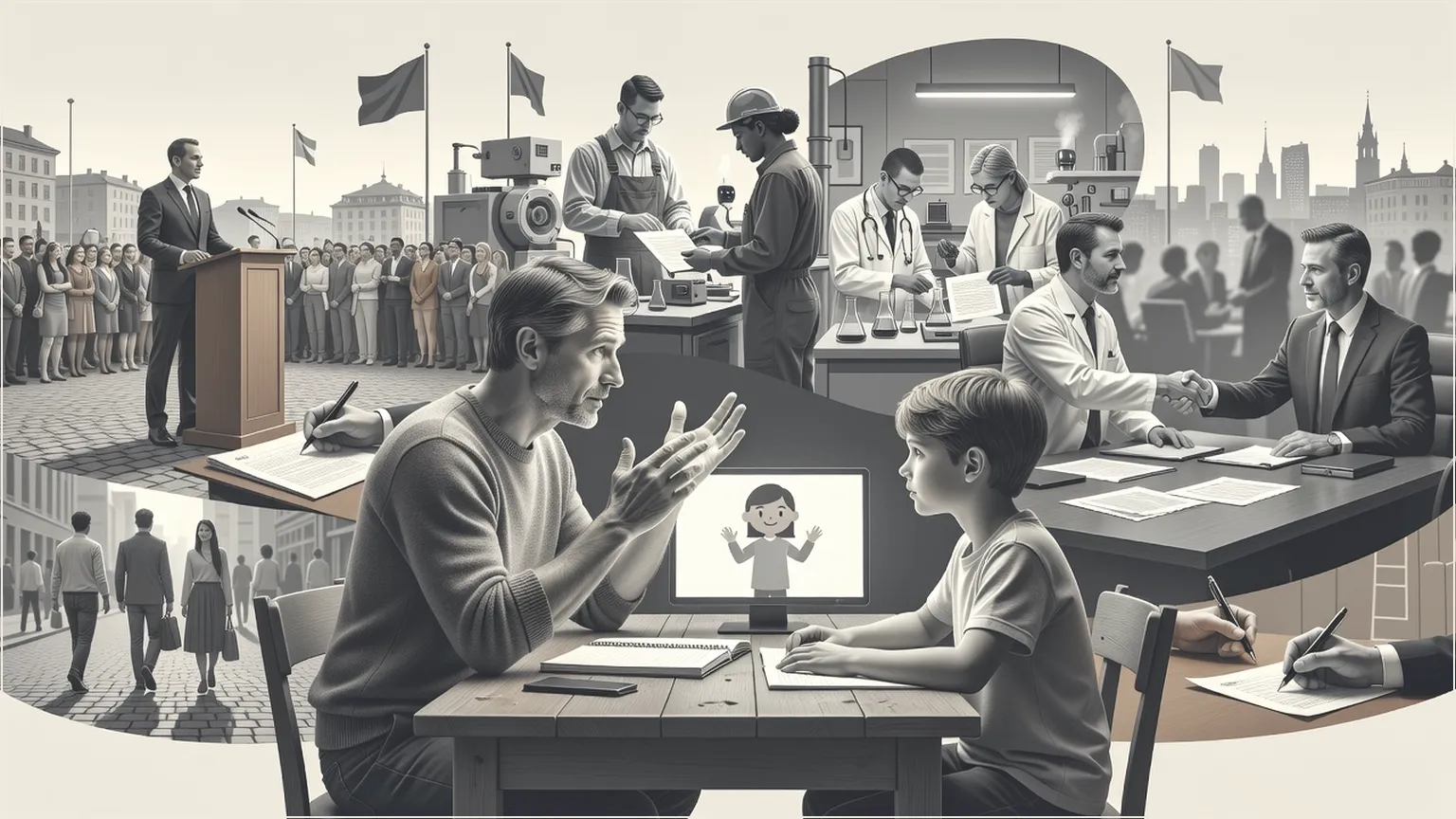
Co-founder Georges Harik and the humans& team framed this as a deliberate break from the "answer the question well" school of AI tutoring toward models built for long-horizon understanding — training against a simulated student rather than a static dataset [3].
The technique matters more than the use case. Training against a simulated counterpart — a stand-in learner, a stand-in customer, a stand-in employee — is a pattern that generalizes well beyond education. Expect to see this simulated-counterpart training approach show up in sales coaching, onboarding, and support agents within the year.
EU and Canada Launch 'Alliance for the Future' on AI and Digital Sovereignty
At the October 29-30 EU-Canada Summit in Montreal, PM Mark Carney, European Council President António Costa, and Commission President Ursula von der Leyen launched a framework explicitly branded as an "alliance for the future," with AI regulation cooperation, Canadian access to EU cloud and AI infrastructure, supercomputing collaboration, critical minerals supply chains, and Erasmus+ participation all on the table [1][2][3].
This is tech sovereignty politics dressed as a trade summit. The subtext is unmissable: both sides are hedging against overreliance on US hyperscalers and Chinese hardware, building out parallel infrastructure and regulatory alignment while they still have leverage to negotiate terms rather than just adopt someone else's stack.
For Nordic companies specifically, this is a preview of the infrastructure map for the next five years — compute access, data governance, and AI regulation are becoming geopolitical bargaining chips, not just domestic policy. Plan your cloud and data residency strategy accordingly.
What This Means For Your Business
Today's news is really one story told four ways: the unit of AI progress has moved from "writing code" to "taking physical or digital action in the world." Vercel's agent-desktop lets an AI operate your actual computer. DeepMind's agents go from a sentence to a dancing physical robot. &Tutor is optimized not to answer well but to produce durable outcomes in a human over time. None of these are about generating better text — they're about agents doing things and being judged on results.
If you're a company still thinking about AI adoption in terms of "which coding assistant should our engineers use," you're playing last year's game. The real question now is: which parts of your operation can you hand to an agent that acts autonomously — on your desktop, in your CAD pipeline, in your customer interactions — and which parts require a human to set direction and evaluate the outcome? That's the orchestration question, and it's rapidly becoming the only question that matters. The EU-Canada alliance is the macro version of this same shift — governments hedging their infrastructure bets because they know compute and AI capability are now strategic assets, not just IT line items.
The TTS benchmark is the useful reality check in all this enthusiasm: even with agents building robots and controlling desktops, we're still at ~10% fool rate on something as "solved" as synthetic voice. Capability is uneven and overhyped in places, genuinely transformative in others. The job of good judgment is knowing which is which before you bet the roadmap on it.
Key takeaway: The winners this cycle won't be the companies with the best prompts — they'll be the ones who figure out fastest which decisions to delegate to agents and which ones demand a human holding the judgment.
Sources
- https://x.com/ctatedev/status/2116323148706771302
- https://github.com/vercel-labs/agent-desktop
- https://x.com/ctatedev/status/2116323151697121498
- https://www.digitaltrends.com/computing/subvocals-glasses-promise-to-let-you-talk-to-your-computer-in-complete-silence/
- https://www.ycombinator.com/companies/the-subvocal-company
- https://x.com/rohanpaul_ai/status/2116245323039592529
- https://cryptobriefing.com/google-deepmind-dancing-robot-text-prompt/
- https://x.com/Google/status/2116555691099934818
- https://x.com/a_ron_saunders/status/2116559314785857766
- https://tutor.humansand.ai/blog/
- https://alphasignal.ai/news/humans-trains-ampersand-tutor-by-teaching-a-simulated-student
- https://x.com/humansand/status/2116186248805249288
- https://www.pm.gc.ca/en/news/news-releases/2026/10/25/prime-minister-carney-host-canada-european-union-summit-montreal
- https://www.consilium.europa.eu/en/meetings/international-summit/2026/10/29-30/
- https://www.lemonde.fr/en/international/article/2026/10/30/canada-and-eu-launch-new-alliance-with-deals-on-ukraine-minerals-and-ai_6767653_4.html
Stay ahead of AI
No spam. Unsubscribe anytime.
Want to go deeper?
Reading the news is one thing. Exploring the frontier is another. See what we're building.